


1. Strategic Context: From Protecting Networks to the Contest for Information Superiority
The digitalization of armed forces has transformed not only their operational technologies, but also the nature of military vulnerability. Modern command-and-control systems, intelligence and reconnaissance assets, air defence, uncrewed platforms, satellite navigation, and core logistics infrastructure all rely on digital networks, software, radio links, and continuous data exchange. Consequently, the ability to collect, process, secure, and transmit information in a timely manner has become a decisive factor in operational effectiveness.
This shift broadens the traditional concept of cybersecurity. Protecting military digital infrastructure is no longer confined to defending computers and static networks against intrusions. Digital systems are inextricably linked to the electromagnetic spectrum (EMS) through radio communications, radar, satellite links, and uncrewed assets. If the availability or integrity of these signals is degraded, system functionality can be severely impaired even without software-level compromise.
Modern defence architectures therefore integrate previously distinct operational fields: cyber operations, electronic warfare (EW / EloKa), signals intelligence (SIGINT), secure communications, and advanced data analytics. Their shared objective is to guarantee that friendly forces maintain access to reliable, real-time intelligence and preserve decision dominance even in heavily contested electronic environments.
The strategic relevance of this operational convergence has grown steadily across Europe over the past two decades. The full-scale war in Ukraine since February 2022 has underscored the decisive impact of synchronizing conventional combat power with cyber operations, electronic countermeasures, uncrewed systems, space-based assets, and information operations. For European defence planners, the lesson is clear: cyber and electromagnetic resilience are fundamental pillars of national and collective deterrence.
Germany initiated institutional capability integration well before 2022. A milestone was the 2017 establishment of the Cyber and Information Domain Service (CIDS / Cyber- und Informationsraum), which unified Bundeswehr capabilities across cyberspace, military IT, intelligence, and the electromagnetic spectrum. However, structural reorganization is only the baseline; true operational capability requires interoperable command-and-control architectures, highly trained personnel, streamlined data-sharing protocols, and the capacity to feed raw intelligence directly into high-tempo tactical decision cycles.
Throughout the early 2020s, CIDS capabilities were systematically integrated into NATO’s collective defence posture. In 2021, CIDS elements—encompassing IT infrastructure, geospatial intelligence (GEOINT), and electronic warfare units—began gearing up for the Very High Readiness Joint Task Force (VJTF). In parallel, EW units prepared for their deployment in VJTF 2023, while CIDS communications elements validated deployable command-post infrastructure and secure mobile networks under tactical conditions.
The “Zeitenwende” (the historic turning point in German security policy) announced on 27 February 2022 accelerated this trajectory. Existing cyber, information, and EW capabilities shifted from supporting expeditionary missions to reinforcing core territorial and alliance defence. An essential structural step followed in April 2024, when the CIDS was formally elevated to an independent military service branch alongside the Army, Air Force, and Navy.
From an information security standpoint, this operational logic expands upon the classic CIA triad (Confidentiality, Integrity, and Availability). While military data must remain protected from unauthorized access, tamper-proof, and accessible on demand, tactical utility is dictated by a critical fourth vector: latency. Highly accurate and secure intelligence loses all tactical value if delivered too late. For the CIDS, cybersecurity is not merely IT perimeter defence, but an end-to-end framework ensuring information remains trusted, actionable, and delivered in real time.
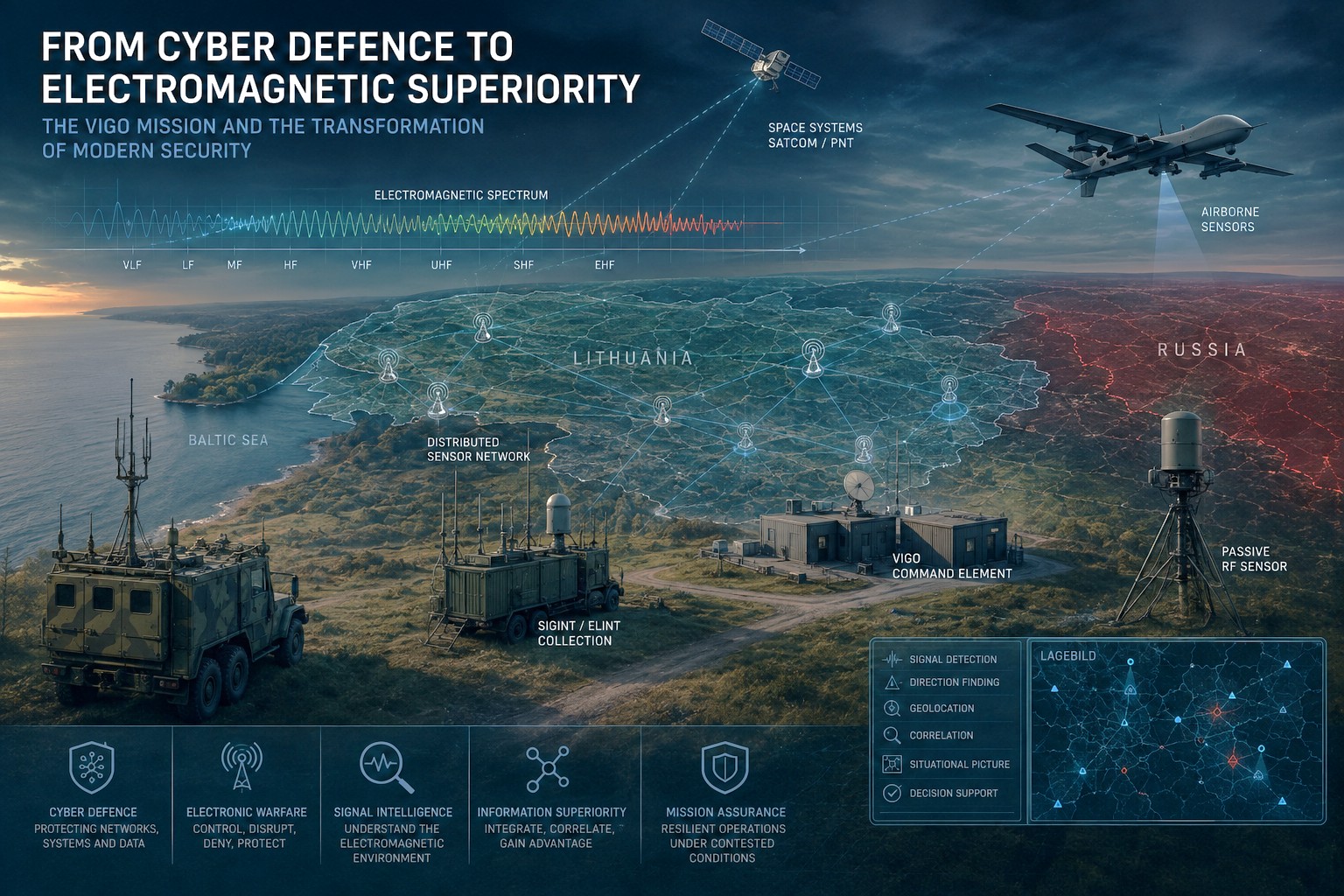
Germany’s VIGO (Vigilant Owl) deployment in Lithuania exemplifies this operational philosophy. VIGO is neither a single radar unit nor an isolated technical platform; it is a networked sensor-to-shooter and reconnaissance architecture fusing electronic intelligence (ELINT) units, multi-spectral sensors, secure digital relays, uncrewed platforms, and tactical command nodes. A core technical pillar of this ecosystem is the mobile Baumfalke reconnaissance system.
VIGO demonstrates a fundamental paradigm shift: moving away from episodic training exercises toward persistent electromagnetic surveillance and the real-time integration of sensor data into the Common Operational Picture (COP). This transition fundamentally reframes cybersecurity analysis. The primary benchmark is no longer whether an isolated server or radio link is secured, but whether the entire kill chain and data loop—from physical signal detection to tactical data processing, operational visualization, and military decision-making—remains resilient against peer-level disruption.
2. The Electromagnetic Spectrum as an Intelligence Source and a Contested Domain
While structural reorganization established the institutional foundation of the CIDS, the operational core lies in mastering the electromagnetic spectrum (EMS). Modern militaries inevitably leave a distinct electromagnetic footprint: tactical radio networks, radar installations, satellite navigation links, uncrewed aerial systems (UAS) datalinks, and multi-spectral sensor suites all depend on radio frequency (RF) emissions. Even when signal payloads are encrypted and content is inaccessible, metadata—such as transmission activity, frequency allocation, pulse repetition intervals, polarization, and lines of bearing (LOB)—provides high-value intelligence.
The EMS is simultaneously an intelligence asset and a contested operational domain. The former drives Signals Intelligence (SIGINT), while the latter defines Electronic Warfare (EW / EloKa) and the broader framework of Electromagnetic Operations (EMO).
SIGINT, COMINT, and ELINT
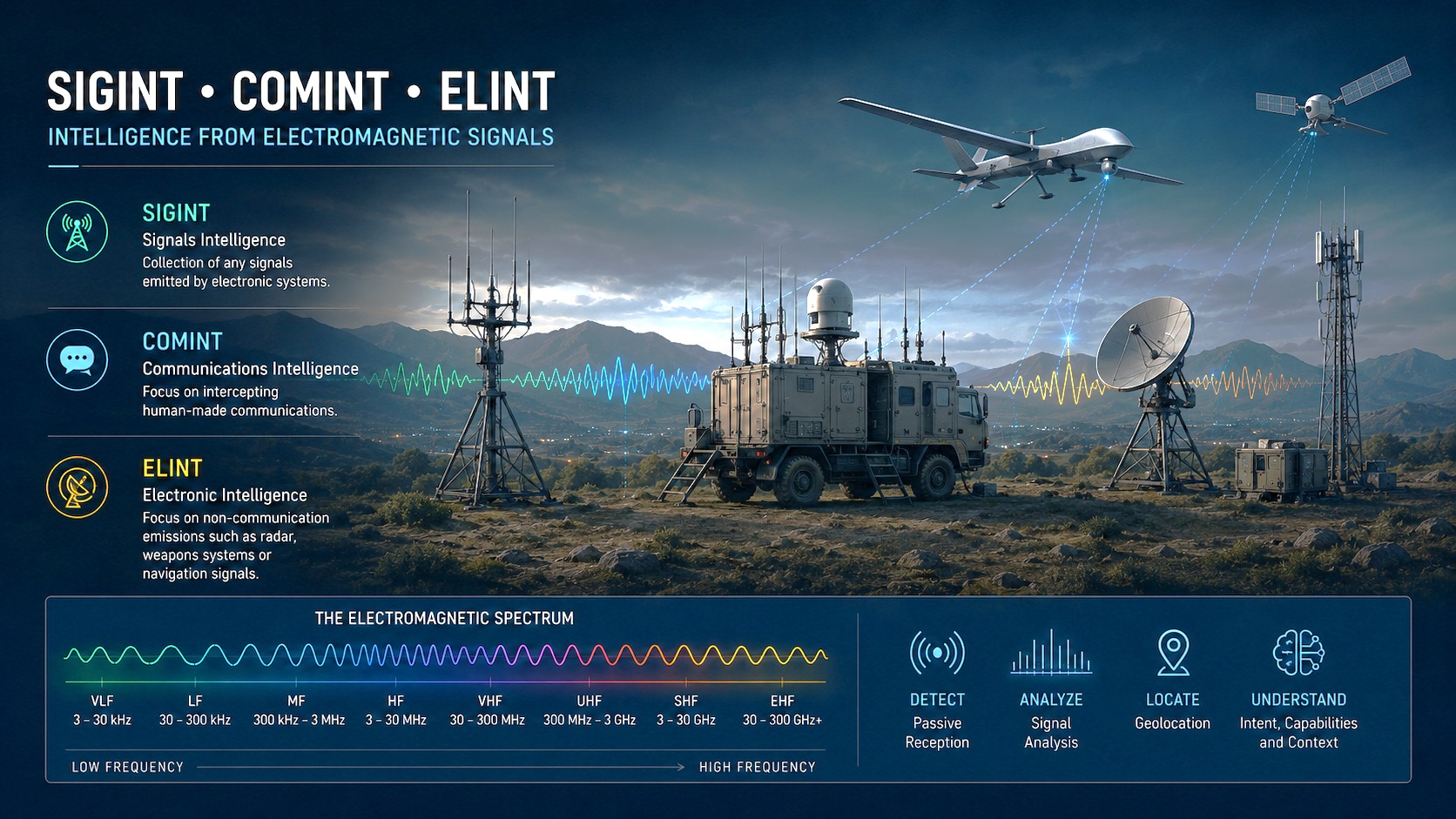
Signals Intelligence encompasses the interception, processing, and analysis of all foreign electromagnetic emissions. Rather than representing a single platform or isolated technology, SIGINT serves as an umbrella discipline divided into two core pillars essential to the VIGO architecture:
-
Communications Intelligence (COMINT): Targets signals used for voice and data transmissions. COMINT’s intelligence value does not rely solely on message decryption. Traffic analysis—monitoring transmission occurrence, frequency agility, burst duration, periodicity, network topology shifts, and transmitter geolocations—enables analysts to map command hierarchies and operational intent without breaking encryption or breaching internal IT systems.
-
Electronic Intelligence (ELINT): Focuses on non-communications electronic emissions, primarily radar and air defence sensor systems. Because active radar must emit high-power electromagnetic pulses to function, it unavoidably exposes an identifiable technical signature. Analyzing carrier frequencies, pulse widths, modulation schemes, and scan rates reveals the specific system type, operational mode (e.g., search, track, or target illumination), and readiness state.
A prime German asset in this field is the TPz Fuchs KWS RMB (Radio Multiband) electronic reconnaissance vehicle, designed for direction-finding (DF), geolocation, and automated signal characterization. Systematically aggregating and analyzing these emissions over time establishes an Electronic Order of Battle (EOB) - a dynamic map of adversary radar deployments, emitter densities, and air defence postures across the theater of operations.
The COMINT/ELINT distinction is vital for understanding VIGO: COMINT exploits communications activity, whereas ELINT exploits technical radar emissions. In both cases, actionable intelligence is derived directly from the physical EMS footprint rather than through cyber exploits or network penetrations.
Electronic Warfare (EloKa): From Passive Surveillance to Active Dominance
While SIGINT extracts intelligence from intercepted emissions, Electronic Warfare encompasses a broader operational mandate: passive surveillance, offensive disruption, and spectrum self-protection. These functions map into three core operational pillars:
| EW Functional Pillar | NATO Terminology | Core Operational Role |
|---|---|---|
| Electronic Support | Electronic Support Measures (ES / ESM) | Intercepting, identifying, and geolocating adversary emissions in real time. |
| Electronic Attack | Electronic Countermeasures (EA / ECM) | Jamming, spoofing, or neutralizing adversary communications, radar, and PNT signals. |
| Electronic Protection | Electronic Protective Measures (EP / EPM) | Shielding friendly sensors, datalinks, and command networks from adversary interference. |
This evolution is codified in doctrine: NATO increasingly employs the comprehensive term Electromagnetic Warfare (EW) within Electromagnetic Operations (EMO). This recognizes that modern combat does not target isolated transceivers but rather contests the entire electromagnetic environment across overlapping military, civil, space, and tactical domains.
This operational overlap exposes a fundamental vulnerability: digital hardening does not guarantee electromagnetic survivability. A cryptographic channel hardened against cyber intrusions remains vulnerable to broadband barrage jamming. An air-gapped mission computer depends entirely on vulnerable external GPS/PNT radio signals. Similarly, an uncrewed system with impenetrable onboard software is neutralized if its line-of-sight (LOS) command-and-control link is severed. Kinetic and non-kinetic mission denial can be achieved without exploiting a single line of software code.
Cyber Operations and Electromagnetic Warfare: Intertwined Vectors
To analyze modern sensor-to-shooter architectures, a clear functional boundary is necessary:
-
Cyber Operations target logic, software code, compute environments, and network protocols.
-
Electromagnetic Warfare operates through the physical RF spectrum to degrade or deny spectrum-dependent functions.
Technologically distinct, they are operationally converged:
A tactical radio is both an RF emitter and an IP network node; a UAS integrates physical avionics, flight-control software, satellite navigation, and RF datalinks; radar returns are processed by onboard software and distributed across shared tactical networks. Consequently, cyber and EW capabilities strike different tiers of the same kill chain. Software exploits corrupt data processing; RF jamming halts data transmission at the physical layer. The operational outcome is identical: decision paralysis and platform mission failure.
Core Principle: Technologically distinct disciplines — operationally converged domains of effect.
The Intelligence Processing Chain: From Raw Emission to the Common Operational Picture
Detecting an isolated emission provides minimal tactical utility. A raw signal must transition through a rigorous intelligence workflow to yield actionable intelligence:
Each phase adds operational value:
-
Spatial Correlation: Multi-node sensor arrays use Time Difference of Arrival (TDOA) and Angle of Arrival (AoA) to transform ambiguous bearings into tight geolocation ellipses.
-
Baseline Profiling: Persistent spectrum monitoring builds baseline behavioral models, allowing automated systems to immediately flag anomalies, frequency hops, or emergency transmission spikes.
-
Sensor Fusion: Correlating ELINT intercepts with optical, radar, and geospatial intelligence (GEOINT) confirms whether an activated emitter reflects a routine radar test or a deployed surface-to-air missile battery.
Operational performance is therefore determined not by individual receiver sensitivity alone, but by sensor-to-decision latency. Modern EW doctrine focuses on automated signal processing, edge computing, and AI-assisted classification to ingest massive RF volumes, filter out ambient noise, and deliver real-time emitter updates to commanders.
This real-time correlation and sensor fusion forms the theoretical blueprint for Germany's operational deployments on NATO’s eastern flank—specifically realized in the Vigilant Owl and VIGO architectures.
3. NATO's Eastern Flank: From Vigilant Owl to the VIGO Reconnaissance Mission
Signals intelligence (SIGINT) and electronic warfare (EW) capabilities achieve maximum operational utility when embedded within a defined geographic battlespace and directly tethered to the tactical formations that rely on their intelligence products. In this operational context, Lithuania serves as a primary testbed and operational hub. Situated on NATO’s northeastern flank—bordering Belarus and the heavily militarized Russian exclave of Kaliningrad along the critical Suwałki corridor—Lithuania occupies a pivotal geostrategic position for multi-domain intelligence collection.
This geography is particularly advantageous for electronic intelligence: radio frequency (RF) emissions transcend sovereign borders, governed strictly by physical propagation characteristics, effective radiated power (ERP), antenna aperture, elevation, and terrain masking. Forward deployment along the border enables deep cross-border standoff surveillance of foreign radar, air defence, and communications emitters without crossing international boundaries or infringing upon foreign airspace.
The Evolution of German-Lithuanian EW Cooperation
Within this operational landscape, bilateral German-Lithuanian electronic warfare cooperation has evolved significantly:
-
2020–2021 (Inception & Training): Initiated under the exercise banner Vigilant Owl, early iterations focused on expeditionary deployment drills, tactical employment of EW systems in a live electromagnetic environment, and establishing basic bi-national interoperability between German EloKa units and Lithuanian armed forces.
-
2022–2024 (Strategic Reorientation & Advanced Interoperability): The geopolitical rupture of February 2022 and subsequent decisions at the NATO summits in Madrid (2022) and Vilnius (2023) reoriented the Alliance toward forward collective defence. German-Lithuanian technical integration deepened, routinely deploying specialized assets such as the TPz Fuchs KWS RMB (Radio Multiband) for synchronized radar direction-finding (DF), geolocation, and technical emitter classification across the Baltic theater.
-
2025–Present (Permanent Forward Presence & Institutionalization): The formal activation of Panzerbrigade 45 (Brigade Litauen) in spring 2025 permanently altered tactical information requirements. A forward-deployed combat brigade requires persistent, real-time situational awareness across all operational domains, with the electromagnetic spectrum playing a critical role in early warning and force protection.
Consequently, Vigilant Owl transitioned from an episodic exercise series into the persistent VIGO (Vigilant Owl) reconnaissance mission. Rather than an abrupt reclassification, this evolution reflects the formal institutionalization of a continuous SIGINT and EW reconnaissance posture embedded within NATO’s forward defence architecture.
The VIGO Architecture: A Networked Sensor Ecosystem
Operationally, VIGO is neither an isolated radar installation nor a monolithic SIGINT asset. It functions as an integrated reconnaissance architecture comprising:
-
Mobile Sensor Nodes: Forward-deployed tactical intercept and direction-finding platforms.
-
Passive EW Interceptors: Systems monitoring radar, datalink, and communications emissions without emitting detectable signals.
-
Tactical Uncrewed Aerial Systems (UAS): Providing aerial relay, multi-spectral observation, and elevated sensor horizons.
-
Encrypted Command & Control (C2) Datalinks: Resilient mobile communications routing raw intercept data to analysis cells.
-
Tactical Command Nodes: Analytical hubs responsible for correlating multi-source inputs into an actionable Common Operational Picture (COP).
A pivotal technological asset within this ecosystem is the mobile Baumfalke electronic reconnaissance prototype. Baumfalke exemplifies the core tenet of network-centric warfare: an intelligence sensor achieves its true force-multiplying potential not as a standalone collector, but when seamlessly fused into a distributed data fabric where sensor data is rapidly processed, cross-referenced, and disseminated.
4. VIGO Architecture: From Raw Signal to the Common Operational Picture
Modern intelligence effectiveness is not defined by individual sensor performance alone. Rather, it depends on the latency, fidelity, and resilience with which raw sensor outputs are transmitted, cross-referenced, and synthesized into a coherent Common Operational Picture (COP). In official Bundeswehr doctrine, VIGO is defined not as a standalone platform, but as a distributed sensor-to-command data mesh linking mobile collection assets, tactical uncrewed aerial systems (UAS), hardened communications relays, and automated data fusion cells.
A central technological pillar of this architecture is the mobile Baumfalke prototype, developed in collaboration with the Cyber Innovation Hub of the Bundeswehr (CIHBw). Designed for the detection, interception, and passive geolocation of hostile radio emissions, the system operates as a tactical edge sensor. While specific technical parameters—such as operational bandwidth, sensitivity, Circular Error Probable (CEP), and internal system architecture—remain classified, its core operational mechanics rely on advanced RF triangulation and timing analysis.
Passive Geolocation via Time Difference of Arrival (TDOA)
The primary geolocation methodology employed by systems like Baumfalke is Time Difference of Arrival (TDOA), also known as hyperbolic multilateration:
-
Hyperbolic Multilateration: When a target transmits an RF signal, that emission arrives at spatially separated sensor nodes at slightly different times due to the finite speed of light (c ≈ 3 × 10⁸ m/s).
-
Timing Cross-Correlation: By synchronizing sensor clocks down to the nanosecond level (via GNSS or high-precision internal atomic standards), the system measures the exact time delta (Δt) between receivers.
-
Spatial Intersection: Each sensor pair generates a hyperbolic line of position (LOP). The intersection of multiple hyperbolas from three or more distributed receivers calculates the precise coordinates of the emitter without requiring directional antenna arrays.
Operational Advantages and Tactical Constraints
-
Zero RF Signature (Passive Interception): Because TDOA sensors do not emit electromagnetic energy, they operate undetected by adversary Electronic Support Measures (ESM). Friendly reconnaissance nodes cannot be targeted via anti-radiation missiles or passive radio direction-finding.
-
Mobility & Terrain Adaptability: Deployable, vehicle-mounted, or mast-mounted mobile nodes can rapidly adapt baseline geometry to terrain masking, foliage, and shifting lines of contact.
-
Geolocation vs. Positive Identification (PID): TDOA delivers an accurate spatial coordinate and technical signal profile, but it cannot independently confirm platform context. An intercepted VHF burst indicates where a transmission occurred, but not who made it or what vehicle carried the radio. Consequently, the architecture relies on sensor cross-cueing—tasking tactical UAS or electro-optical/infrared (EO/IR) assets to confirm and positively identify the target at the calculated coordinates.
Multi-Sensor Data Fusion and Real-Time C2 Integration
A solitary line of bearing or TDOA coordinate possesses negligible tactical utility until it enters the automated intelligence pipeline. Within the VIGO ecosystem, forward collection nodes continuously route structured telemetry to tactical operations centers (TOC) and command posts for Multi-Sensor Data Fusion (MSDF).
In this pipeline, automated correlation algorithms ingest real-time RF intercepts alongside radar tracks, optical UAS reconnaissance, and historical Electronic Order of Battle (EOB) datasets:
-
False Alarm Reduction: Cross-referencing simultaneous detections filters out ambient commercial RF noise and deliberate adversary electronic decoys.
-
Aggregated Threat Profiling: Combining real-time emitter coordinates with known doctrinal deployment patterns enables automated recognition of high-value targets (e.g., surface-to-air missile command posts or artillery counter-battery radars).
-
Compressed Decision Latency: According to the Bundeswehr, telemetry from forward sensors feeds directly into tactical command-and-control networks in near-real time, eliminating the analytical bottlenecks of manual reporting.
While this distributed architecture multiplies situational awareness, it introduces critical systemic dependencies: the entire kill chain relies on nanosecond-accurate clock synchronization, high-throughput encrypted datalinks, data integrity verification, and resilient network fabrics.
This operational reality bridges electronic warfare directly with cybersecurity: the validity of the operational picture depends fundamentally on the integrity and cyber survivability of the data pipeline that produces it.
5. Cybersecurity in Distributed Intelligence Architectures: Establishing Trust in the Common Operational Picture
The operational efficacy of architectures like VIGO hinges on deep interconnectivity—rapidly capturing, routing, correlating, and visualizing multi-sensor telemetry within a unified Common Operational Picture (COP). However, this distributed data fabric expands the adversarial attack surface. Rather than comprising standard IT hardware alone, a modern SIGINT/EW architecture spans a multi-tiered ecosystem of physical radio-frequency (RF) sensors, ambient propagation media, Positioning, Navigation, and Timing (PNT) constellations, tactical edge compute nodes, secure IP datalinks, and human command elements.
Consequently, information assurance in distributed reconnaissance fundamentally transcends traditional perimeter defence. Verifying that a network is shielded from unauthorized access is insufficient if the intelligence feeding tactical decision-makers has been delayed, spoofed, or manipulated. The primary mandate of cybersecurity shifts from protecting isolated devices to guaranteeing the end-to-end integrity, authenticity, and timeliness of the entire data pipeline.

Physical and RF-Layer Vulnerabilities: Spectrum Manipulation
Because radio-frequency collection nodes and wireless links rely on raw electromagnetic signals, adversaries can compromise mission capability at the physical layer without exploiting software vulnerabilities or breaching network firewalls:
| Vector | Primary Impacted Metric | Threat Mechanism & Tactical Impact |
|---|---|---|
| RF Jamming | Availability | Broadband barrage or responsive spot-jamming degrades signal-to-noise ratios (SNR), severing tactical datalinks and blinding passive intercept receivers. |
| Signal Spoofing | Integrity & Authenticity | Injecting falsified RF signals into receiver arrays. When targeting GNSS, spoofing distorts position fixes and desynchronizes nanosecond-accurate internal clocks critical for TDOA multilateration. |
| RF Deception & Decoys | Integrity & Context | Adversary deployment of programmable RF emitters replicating high-value radar signatures. This skews algorithmic classification and consumes analytical bandwidth. |
In this contested environment, Multi-Sensor Data Fusion (MSDF) functions as a defensive validation tool. Cross-referencing disparate intelligence vectors—such as comparing an ELINT Line of Bearing against an electro-optical UAS feed—identifies data anomalies. Sensor contradictions cease to be mere processing errors; they serve as active indicators of adversary electronic manipulation.
Data Integrity and Cryptographic Provenance
Even an uncorrupted raw intercept remains vulnerable as it traverses the digital exploitation pipeline:
Unauthorized manipulation or latency injection at any stage in this sequence corrupts the resulting operational assessment. Distributed architectures therefore require strict data provenance and lineage tracking. Command systems must cryptographically trace every displayed track to its origin point, certifying:
-
The precise sensor node and calibration state that captured the raw emission.
-
The cryptographic keys used during tactical transit.
-
Every intermediate algorithmic transformation applied during data fusion.
Architectural Hardening: Zero Trust and Supply Chain Governance
To counter internal and lateral threats across distributed nodes, modern military IT models adopt the principles of Zero Trust Architecture (ZTA), as formalized in NIST SP 800-207. Rather than granting implicit trust based on physical network location, access control is governed by strict identity verification, contextual telemetry, and automated policy enforcement. Implementing the Principle of Least Privilege (PoLP) and dynamic micro-segmentation ensures that if a forward collection node (e.g., an isolated Baumfalke unit) is physically overrun or digitally compromised, lateral movement into the broader tactical network is systematically contained.
While publicly available records do not document the exact cryptographic specifications of VIGO, Zero Trust serves as the primary analytical benchmark for isolating contested nodes and enforcing continuous validation across the network fabric.
This zero-trust baseline extends across the platform lifecycle through Cybersecurity Supply Chain Risk Management (C-SCRM) (NIST SP 800-161 Rev. 1):
-
Hardware & Firmware Integrity: Validating microelectronic components against hardware trojans and firmware-level backdoors before integration into active service.
-
Software Bills of Materials (SBOM): Continuous auditing of operating system kernels, third-party libraries, and analytical algorithms to eliminate supply chain vulnerabilities prior to deployment in air-gapped environments.
Command Node Redundancy: From Hardening to Cyber Resilience
Tactical operations centers (TOCs) and mobile command posts represent high-value nodes where multi-source intelligence converges into the operational picture. This concentration of decision-critical data creates an inherent operational vulnerability.
To mitigate single points of failure, modern doctrine transitions from brittle perimeter prevention to cyber resilience: the capacity of a distributed system to absorb hostile electronic or cyber action, sustain core mission-essential functions under degraded conditions, and rapidly reconstitute full operational capability.

This resilience is operationalized through Defence-in-Depth, aligning protection measures across every layer of the kill chain:
-
Electromagnetic Layer: Low Probability of Intercept / Low Probability of Detection (LPI/LPD) waveforms, adaptive beamforming, and anti-jamming antenna arrays.
-
Network Layer: Dynamic mesh routing, redundant PACE (Primary, Alternate, Contingency, Emergency) communications plans, and zero-trust micro-segmentation.
-
Data Layer: Cryptographic hashing, automated cross-sensor consistency checks, and data lineage tagging.
-
Cognitive Layer: Presenting confidence scores and data origin flags directly to tactical commanders to safeguard against cognitive manipulation.
Ultimately, the central asset under protection is neither an individual radio transceiver nor an isolated server rack: it is decision confidence in the Common Operational Picture. Ensuring that the digitized battlefield representation accurately reflects physical reality enables commanders to execute command and control with speed and precision.
6. Conclusion: VIGO as a Paradigm for Resilient Cyber-Electromagnetic Architectures
The operational evolution demonstrated by VIGO underscores a broader military paradigm shift: modern combat effectiveness is driven less by isolated sensor specifications than by the seamless integration of disparate technical layers into a unified, resilient intelligence architecture. Signals intelligence (SIGINT, COMINT, and ELINT) extracts critical indicators from the electromagnetic environment; mobile edge systems such as Baumfalke enable passive geolocation via Time Difference of Arrival (TDOA); tactical uncrewed aerial systems (UAS) provide cross-cueing and visual verification; secure datalinks route high-volume telemetry; and command elements fuse these heterogeneous inputs into a real-time Common Operational Picture (COP).
This operational logic maps directly into an end-to-end sensor-to-decision pipeline:
The decisive metric for such architectures is system-wide latency, fidelity, and survivability. A high-sensitivity sensor offers negligible tactical value if its outputs arrive too late, fail to correlate with multi-domain intelligence, or suffer undetected tampering in transit. Consequently, defence analysis must shift from a platform-centric perspective to a network-centric framework, in which the survivability, throughput, and integrity of the data fabric itself constitute the primary force multiplier.
Cybersecurity as a Strategic Enabler in Contested Domains
In distributed reconnaissance architectures, cybersecurity transcends traditional administrative IT support. It functions as a strategic operational enabler tasked with ensuring that intelligence remains trusted, available, and actionable under active electronic degradation, cyber exploitation, or node loss.
Because cyber and electromagnetic vectors converge at the tactical edge, the originating layer of an adversary disruption—whether RF barrage jamming at the physical layer or packet injection at the network layer—is secondary to its tactical effect: the corruption, latency, or denial of the Common Operational Picture.
Core Architectural Priorities for Multi-Domain Systems
To maintain operational integrity in contested peer-conflict environments, distributed cyber-electromagnetic systems depend on five core design priorities:
-
Electromagnetic & PNT Resilience: Distributed sensor grids must sustain continuous operations during severe RF jamming, GPS denial, or network fragmentation through alternative PNT (e.g., chip-scale atomic clocks, celestial/inertial navigation) and Low Probability of Intercept / Low Probability of Detection (LPI/LPD) waveforms.
-
Cryptographic Data Provenance & Sensor Authentication: Countering sensor deception and data injection requires immutable data lineage tracking, cryptographically authenticated sensor telemetry, and automated cross-sensor correlation to detect manipulated feeds.
-
Zero Trust & Least Privilege (ZTA): Applying granular micro-segmentation and continuous identity validation ensures that the physical capture, electronic exploitation, or cyber compromise of an isolated forward sensor node (e.g., a Baumfalke unit) cannot propagate laterally into the core command network.
-
Cyber Resilience & Degraded Operations: Architectures must be engineered for contested environments—incorporating dynamic PACE (Primary, Alternate, Contingency, Emergency) communications plans, graceful functional degradation, and automated self-healing data fabrics.
-
AI Model Assurance & Calibrated Oversight: As dense RF environments mandate AI-driven signal classification and anomaly detection, algorithms must be hardened against adversarial training-data poisoning, with clear human-in-the-loop validation gates to prevent automated ingestion of false tracks.
Methodological Scope and OSINT Boundaries
This analysis is necessarily bounded by the limits of open-source intelligence (OSINT). Publicly accessible records confirm VIGO's operational integration, the tactical employment of Baumfalke, the core application of TDOA multilateration, and the broader institutional role of the Cyber and Information Domain Service (CIDS). However, proprietary and classified parameters—including internal bus topologies, proprietary cryptographic algorithms, digital signal processing (DSP) pipelines, receiver sensitivities, and hardware-level failover schemes—remain protected.
Accordingly, this analysis focuses on an architectural-level threat assessment, evaluating systemic dependencies, failure modes, and threat vectors without relying on speculative technical assertions.
Final Synthesis: From Perimeter Defence to Mission Assurance
The central conclusion extends far beyond VIGO: the more tightly intelligence sensors, communications relays, and command elements are networked, the less cybersecurity can be treated as an isolated boundary control problem. Security must envelop the entire operational lifecycle of data—from physical wave propagation to tactical display.
In modern multi-domain warfare, Mission Assurance supersedes static perimeter defence. Operational success does not require eliminating every conceivable disturbance but maintaining the ability to generate a sufficiently trusted operational picture and preserve decision superiority under continuous adversary action.
Bibliography
-
Bundeswehr (2026). Mission VIGO: Reconnaissance on the Eastern Flank.(Accessed: 10 August 2026).
-
Bundeswehr (2026). Deployment of "Baumfalke" as Part of VIGO in Lithuania. (Accessed: 10 August 2026).
-
Bundeswehr (2026). Cyber and Information Domain Service Headquarters. (Accessed: 10 August 2026).
-
Bundeswehr (2026). 45 Armoured Brigade. (Accessed: 10 August 2026).
-
Bundeswehr (2023). VJTF 2023: Very High Readiness Joint Task Force. (Accessed: 10 August 2026).
-
Federal Ministery of Defence, Germany (BMVg) (2026). Bundeswehr Cyber Innovation Hub (CIHBw) (Accessed: 10 August 2026).
-
Bundeswehr (2026). Electronic Warfare in National and Collective Defence. (Accessed: 10 August 2026).
-
Deutscher Bundestag (2022). Printed Paper 20/846: Motion for a Resolution on the Federal Chancellor's Government Statement on the Current Situation. (Accessed: 10 August 2026).
-
Deutscher Bundestag (2022). The "Zeitenwende" in the European Security Order. (Accessed: 10 August 2026).
-
Federal Ministery of Defence, Germany (BMVg) (2018). Opening Address by Federal Minister of Defence Ursula von der Leyen at the Munich Security Conference on 16 February 2018. (Accessed: 10 August 2026).
-
NATO (2026). Electromagnetic Warfare. NATO Topics. (Accessed: 10 August 2026).
-
National Institute of Standards and Technology (NIST) (2020). Zero Trust Architecture. NIST Special Publication 800-207. (Accessed: 10 August 2026).
-
National Institute of Standards and Technology (NIST) (2022). Cybersecurity Supply Chain Risk Management Practices for Systems and Organizations. NIST Special Publication 800-161 Rev. 1. (Accessed: 10 August 2026).
-
Fraunhofer Institute for Communication, Information Processing and Ergonomics (FKIE) (2026). Sensor Data & Information Fusion (SDF): Research on Distributed Sensor Systems and Reliable Navigation. (Accessed: 10 August 2026).
- US Department of the Army (2014). Cyber Electromagnetic Activities (CEMA). Field Manual (FM). Washington, D.C.: Headquarters, Department of the Army.
-
NATO Cooperative Cyber Defence Centre of Excellence (CCDCOE) (2026). Strategic Overview of the Convergence of Cyber and Hybrid Threats. (Accessed: 10 August 2026).